
In today’s digital world, business telecoms services are essential. They keep teams at the office and home connected, ensure smooth customer interactions, and maintain operational efficiency.
However, choosing the right telecoms solution can be overwhelming. Hidden costs, commission-hungry salespeople, unreliable providers, and outdated technology often lead to frustration, inefficiencies, and financial waste.
At i2 Security & Fire Protection, we understand the critical role of telecoms in business success. That’s why we partner with iTEXS Telecom Ltd, a leading UK telecoms provider. Together, we offer businesses expert guidance on selecting, installing, and maintaining the best business telecoms solutions.
This article discusses the costs, features, and key considerations of business telecoms services. It will help you make an informed decision that boosts productivity and security.

Business telecoms enable secure communication through voice, data, and video. Key business telecommunications include VoIP, business mobile connectivity, fibre broadband, and unified communications.
In an era of hybrid working, IP handsets and cloud-based phone systems keep employees connected from any location. This helps businesses adapt quickly to new operational demands.

A VoIP phone enables voice calls over the internet. It reduces costs compared to traditional phone lines and offers flexible scalability.
Advanced features, such as auto-attendants, call analytics, call recording, and video conferencing, support efficient business communication for remote and hybrid teams.
Benefits:
Hosted telephony (or Hosted VoIP) operates via the cloud, removing the need for an on-site business telephone system.
It simplifies management with features like call forwarding, voicemail-to-email, and real-time analytics. These features are usually accessible via web portals or apps.
Benefits:
On-premise PBX (Private Branch Exchange) systems offer businesses control over internal communications with customisable setups and strong data security.
SIP trunking connects PBX systems to the Public Switched Telephone Network (PSTN) over the internet. It reduces business phone costs and increases flexibility without additional hardware.
Benefits:
Business mobile solutions support communication for on-site, remote, and field-based employees.
Features like Mobile Device Management (MDM) and Bring Your Own Device (BYOD) ensure secure data access across devices.
Benefits:
Reliable business broadband supports everything from VoIP to cloud applications. Businesses can choose from core and advanced solutions.
Benefits:
UC integrates voice, video, messaging, and file-sharing into one platform. This streamlines collaboration and improves productivity.
Built-in security features like end-to-end encryption and multi-factor authentication (MFA) protect sensitive data.
Benefits:

Calculating business telecom costs requires more than reviewing subscription fees.
Key cost drivers include:
Providers offer several pricing models tailored to business needs:
Beyond headline fees, hidden costs can significantly impact the total cost of ownership:
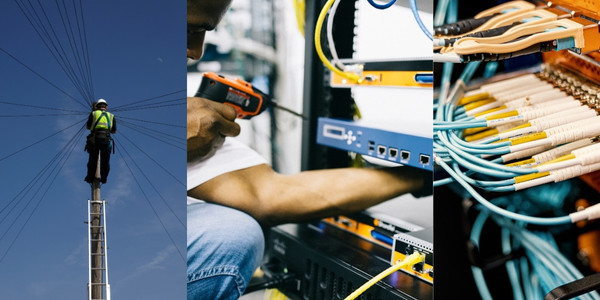
Effective telecom installation and proactive maintenance ensure reliable performance, strong security, and long-term operational stability.
Installation starts by assessing existing infrastructure to identify performance, security, and scalability gaps. This assessment informs decisions on the best-fit solutions, such as VoIP, unified communications, or secure connectivity systems.
After defining requirements, configuration includes hardware setup, security protocols, and IT system integration. Key considerations include firewall settings, QoS configurations for data prioritisation, and security protocol alignment.
Before deployment, systems undergo rigorous testing for performance and compatibility. This includes stress testing for high-traffic scenarios and failover simulations to ensure business continuity. It also covers integration checks with applications like CRMs.
Finally, user training ensures staff can fully leverage the new systems and reduces reliance on IT support.
Continuous monitoring is essential for maintaining system performance and security. This includes real-time tracking of network health and proactive alerts for potential issues. It also covers performance analytics to identify areas for optimisation.
Security management is equally critical. Regular software updates, patch management, and advanced threat detection mitigate risks like DDoS attacks and VoIP vulnerabilities.
A robust disaster recovery plan ensures operational resilience during unexpected disruptions. This includes built-in redundancy, failover protocols, and business continuity strategies.

Choosing the right business telecoms provider goes beyond cost considerations. The ideal provider enhances efficiency, drives growth, and strengthens long-term resilience. These are the key factors to consider—and why we recommend iTEXS Telecom Ltd.
Reliability and Performance
A provider’s reliability can directly impact business continuity. To ensure seamless operations, choose providers with strong SLAs and proactive monitoring. A proven track record of minimal disruptions is also essential.
Scalability and Flexibility
Your telecom infrastructure should evolve with your business. A capable provider offers solutions that scale quickly. This includes adding new users, expanding to new locations, and integrating new technologies without costly overhauls.
Security Considerations
Security is critical for protecting sensitive business data and maintaining system integrity. Providers should implement end-to-end encryption, IDS, and secure remote access protocols like VPNs. Compliance with standards such as GDPR and ISO 27001 reflects a strong security posture.
Business Continuity and Redundancy
Downtime can lead to significant operational and financial losses. Providers should offer business continuity solutions. These include redundant network paths, automatic failover systems, and disaster recovery plans. Technologies like SD-WAN enhance resilience by routing traffic through stable connections.
Responsive Support and Transparent Pricing
Effective support is vital for minimising downtime and quickly resolving issues. Choose a provider with 24/7 customer assistance, rapid response protocols, and clear escalation paths.
Transparent pricing is equally important. To avoid unexpected fees, ensure all costs, from installation to maintenance, are outlined upfront.
Based on these criteria, iTEXS Telecom Ltd, in partnership with i2 Security & Fire Protection, stands out for its reliability, security, and customer support.
This combination of expertise, proactive management, and client-focused support is why we recommend iTEXS Telecom Ltd.

“At i2 Security, we only partner with the best. iTEXS Telecom shares our commitment to quality, ensuring businesses receive secure, scalable, and high-performance telecom solutions.”
Adrian Beesley – Managing Director
i2 Security & Fire Protection

“iTEXS Telecom Ltd and i2 Security & Fire Protection have worked together on installations and recommended their clients to each other since 2018. This new partnership is a logical progression of the relationship, as trust between both parties is now firmly established.”
Colin Finch – Managing Director
iTEXS Telecom Ltd
Background
Westminster Healthcare operates 18 offices across the South East, providing home-based care services. In 2019, they engaged iTEXS Telecom to replace outdated BT Versatility telephone systems. These systems, discontinued in 2011, posed risks due to limited parts availability.
Challenges
Solution
iTEXS completed a 12-month system upgrade across all sites, minimising downtime. Key actions included:
Results
Conclusion
iTEXS significantly strengthened Westminster Healthcare’s communication resilience. This enabled continuous, reliable service for critical healthcare operations, where every call matters.
“We own and run a large warehouse-style non-food retail premises with over 25 handsets throughout the premises. We have been using iTEXS Telecom Ltd for several years now. Colin and his team have been excellent. The move over from our old provider was seamless. Not that we get many issues, but on the occasions we have, they have been swiftly resolved. I would highly recommend iTEXS Telecoms.”
Tom Allitt – Managing Director
“Chroma Surveyors is a company with multiple offices throughout the South and Midlands. We needed a solution that enabled our employees to answer and transfer calls between agents and offices, regardless of their location. We now use mobile phone apps and console software to allow remote working, and to date, this set-up, provided and installed by iTEXS, does exactly what we need.”
Keith Chapman-Burnett – Owner
The four primary types of telecommunication services are voice, data, internet, and cloud services.
In business, telecom refers to using telecommunication technologies to facilitate communication and data exchange within and outside the organisation. This includes services like telephony, internet access, and networking solutions.
Telecommunication services enable the transmission of voice, data, video, and other information over distances. They provide the infrastructure and services necessary for communication between individuals, businesses, and devices.
As of October 2024, Vodafone is the largest telecommunications company in the UK, with a market capitalisation of approximately $25.48 billion. BT Group is the second-largest, with a market capitalisation of nearly $18.45 billion.
British Telecom rebranded to BT in 1991.
Tier 1 telecom companies in the UK are major operators with extensive network infrastructure and coverage. These include BT/EE, Virgin Media, Vodafone UK, Three UK, and Sky.
Yes, BT is phasing out the Public Switched Telephone Network (PSTN). The complete switch-off is scheduled for January 2027, transitioning all traditional landline services to digital, internet-based alternatives. However, this date is fluid and has been pushed back several times.
Choosing the right business telecoms services is more than a technical decision. It’s a strategic investment in your company’s efficiency, security, and growth.
Whether VoIP, broadband, or unified communications, the right telecoms solution ensures seamless connectivity. It also supports remote work, protects your business data and presents a professional image to your customers.
Beyond technology, businesses need partners who understand their challenges. These partners should deliver solutions that evolve with business needs.
At i2, we know that no two businesses are identical. That’s why we partner with iTEXS Telecom, a trusted leader in bespoke telecom solutions. Together, we provide expert-led services tailored to your business, keeping you connected, productive, and secure—today and as your business grows.
Don’t let outdated or unreliable telecom systems limit your business potential. Contact iTEXS Telecom today to discuss your business’s unique communication needs.